
By Joseph B. Evans *
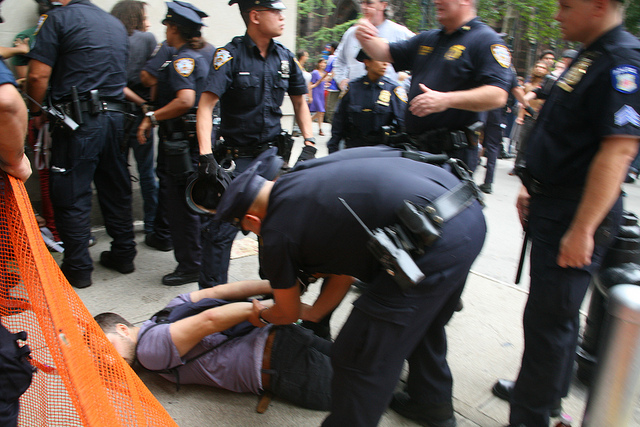
In its June, 2016 decision Figueroa v. Mazza, et al., the Second Circuit reversed the dismissal of claims against police onlookers who failed to step in while a suspect was punched in the face by a fellow officer for no apparent reason. In limiting the “it all happened so fast so there was nothing I could do about it” defense, the decision may mean more success for plaintiffs against police officers who stand idle while other officers use excessive force.
A failure to intervene claim hinges on whether or not the police officer onlooker could have stopped the use of force had he or she stepped in. According to the Figueroa Court, “A police officer is under a duty to intercede and prevent fellow officers from subjecting a citizen to excessive force, and may be held liable for his failure to do so if he observes the use of force and has sufficient time to act to prevent it.”
Generally, a failure to intervene plaintiff must establish that the officer had a realistic opportunity to intervene and prevent the harm; a reasonable person in the officer’s position would know that the victim’s constitutional rights were being violated; and the officer does not take reasonable steps to intervene. The onlooking police officer does not have to be involved in the actual arrest to be liable for the failure to intervene, as long as the Court determines that the officer could have and should have intervened. Indeed, the Court in Figueroa held that “liability attaches on the theory that the officer, by failing to intervene, becomes a ‘tacit collaborator’ in the illegality.”
In Figueroa, a Brooklyn Duane Reade employee received eleven phone calls from an unidentified woman pleading with the employee to track down a file of photographs and delete the order without developing the photos. By the time the employee found the order, they had already been developed, depicting a naked and distressed young boy in a public bathroom. The employee called the police.
The police began to investigate the matter and discovered it was the child’s mother who had taken the pictures. She claimed that the child’s father was sexually abusing their child, and took the pictures to document his pre-visitation physical condition. When the police traced the phone number that originally called the Duane Reade, it led to a man named Eli Samuel, a cult leader and the mother’s spiritual advisor.
Eventually, the police arrested Samuel and placed him in the back of an unmarked police car with two officers in the front seat. According to Samuel, an unidentified officer opened the cruiser’s back door, grabbed Samuel, and punched him over and over again. The officers in the front seat did nothing to intervene. After the ordeal, he was charged with endangering the welfare of a trial, but the case never made it to trial.
Once the charge against Samuel were officially dropped, he sued the arresting officers in the Eastern District of New York, under a variety of civil rights claims, including excessive force, and a failure to intervene claim against the officers in the front seat. Samuel testified that an unidentified officer opened the cruiser’s back door, grabbed Samuel, and punched him over and over again. The officers in the front seat did nothing to intervene.
A jury found in favor of the plaintiffs on all counts, but failed to reach a verdict for the failure to intervene charge. After the verdict, the Court granted the defendants’ motion for a directed verdict, and found in favor of the police officers. With respect to the failure to intervene claim, the Eastern District ruled that “when an assault ‘takes place in ‘less than thirty seconds,’ officers who are present lack ‘sufficient time to intercede in order to prevent the assault.”
The Second Circuit affirmed the dismissal of the false arrest, assault and excessive force claims, but reversed the District Court’s dismissal of the failure to intervene allegations. The Circuit rejected the District Court’s assertion that if an assault takes place in “less than thirty seconds” other officers could not have had time to respond.
The Circuit reasoned that the analysis of a police officer’s responsibility to intervene should factor more than simply the duration of the assault, but also the number of officers present, the officer’s physical position, any obstacles that may have hindered the officer’s ability to step in, the environment, and countless other considerations. The bright line solution would keep a reviewing court from delving into a host of other factors to evaluate the “officer’s ability to stop it from happening” and to answer the ultimate question of whether the officer genuinely became a “tacit collaborator” in the misconduct of another.
Figueroa v. Mazza is a roadmap for failure to intervene cases, allowing plaintiffs better access to relief where the assailant’s identity is unknown. In Figueroa, the plaintiff complained of being punched multiple times by an “unknown officer.” This seemingly basic issue is a very real obstacle for police brutality plaintiffs. After a complete jury trial, pre and post-trial motions and an appeal, the plaintiff was never able to identify the “unknown officer,” who was not named in the arrest report.
Since Figueroa was decided, at least one District Court has already relied on it to deny a police officer’s motion to dismiss a case on summary judgment. In Mendoza v. McLean, the plaintiff was suspected of and arrested for robbing a nearby ShopRite. [1] In his civil suit against the arresting officers, the plaintiff claimed that police kicked and struck him, and used a “police dog to bite him repeatedly,” while he was on “all fours” and “stuck in a thorn bush.” During the deposition the officer stated that the struggle between the plaintiff and the dog lasted “a minute or 2.”
The Court cited Figueroa in reasoning that “even assuming that the assault lasted less than twenty seconds’ the failure to intervene claim [is]‘for the jury to decide.’” Despite classifying this as a “close call,” the court recognized that “a reasonable jury” could find that the officer should have known the use of force on display before him was excessive and stepped in following Figueroa.
The rejection of the bright-line temporal approach allows for the possibility of failure to intervene liability, even when the alleged assault was short in duration. Indeed, Figueroa expands the strike-zone for failure to intervene claims, especially for plaintiffs bringing claims against officers who were present at the scene of the crime when the actual assailant remains unidentified.
[1] Mendoza v. Mclean, No. 14-cv-3231, 2016 WL 3542465 (S.D.N.Y. Jun. 23, 2016).
*Joseph B. Evans is an associate at Gage Spencer & Fleming LLP.
(Photo by Brennan Cavanaugh without alternation via Creative Commons)
