
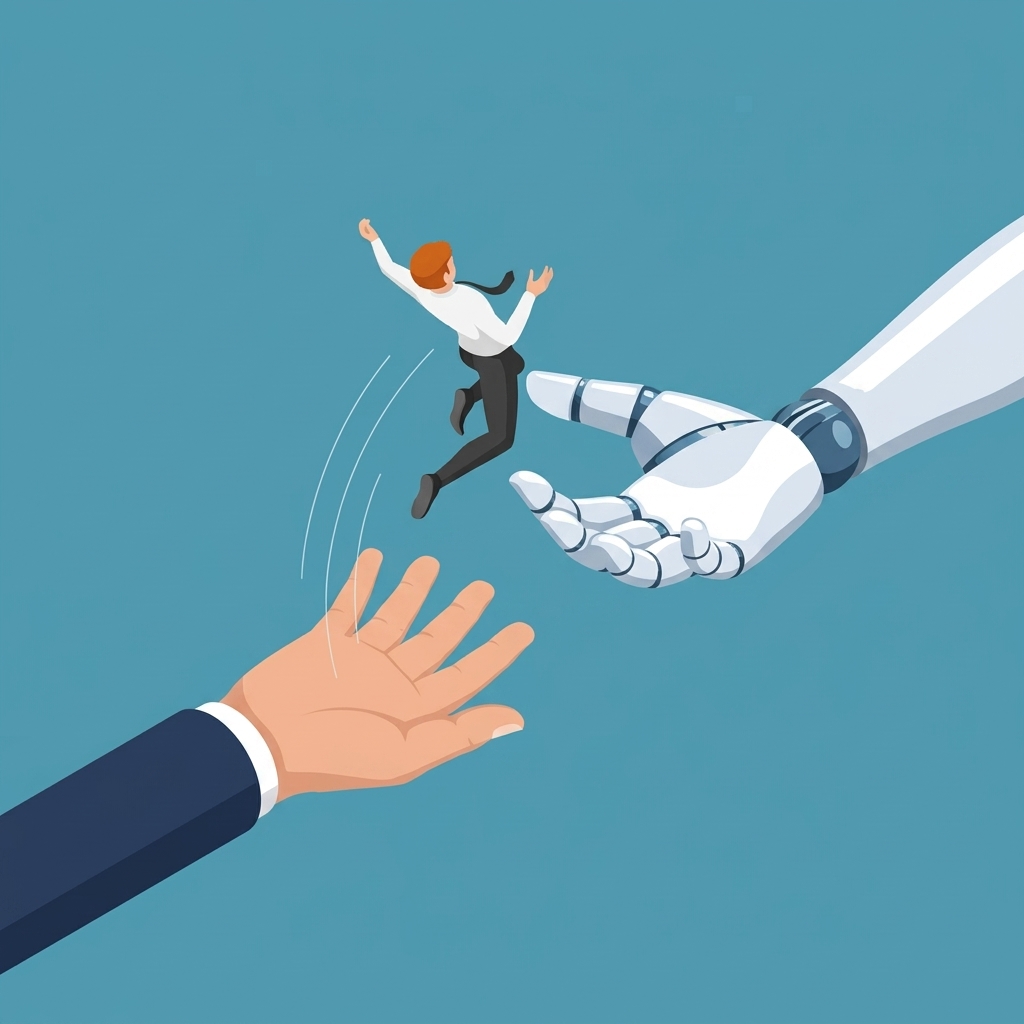
As businesses integrate artificial intelligence (AI) into their workflows, it is important that they understand the liabilities they assume. First-year law students learn that business owners are liable for the actions of employees that fall within their scope of employment.[1] This doctrine is known as respondeat superior: a principal is responsible for its agent.[2] However, a business that hires an independent contractor is typically not liable for vendor-caused injuries.[3] This is known as the independent contractor rule. Exceptions to the rule, including negligent selection, peculiar risk, and nondelegable duties, reflect judgments about which party can best prevent a particular injury.[4] That party is deemed the cheapest cost-avoider.[5] Each exception to the rule has since developed, considering human actors and observable actions. AI vendors complicate traditional liability schemes by selling systems with algorithms, training data, and design choices that are outside the hiring business’s control. This article argues that when injuries arise from nondelegable duties performed by AI vendors, liability should not automatically remain with the hiring business. The relevant inquiry is whether the hiring business remains the cheapest cost-avoider.
Understanding Traditional Vendor Liability
The independent contractor rule rests on the differences between employees and contractors. While employees work under an employer’s control, independent contractors control their own work. Under the doctrine of respondeat superior, an employer is vicariously liable for an employee’s negligence if it occurs within the employee’s scope of employment.[6] That doctrine does not reach independent contractors. “[U]nlike a mere employee, the [independent contractor]receives authority to determine how the work is to be performed and assumes a corresponding responsibility to see that the work is performed safely.”[7] Because of their lack of control, courts are reluctant to hold businesses liable for vendor-caused injuries.
Vendors can insulate businesses from liability, but courts cautiously avoid creating rules that outsource risk. The rule’s exceptions are developed on a case-by-case basis and generally fall into three categories. First, businesses are liable when they are negligent in selecting, instructing, or supervising the contractor.[8] This exception turns on whether the business exercised reasonable care. Second, businesses are liable for work that poses a peculiar risk, meaning it is inherently dangerous unless special precautions are taken. This ensures that the “person for whose benefit the [inherently dangerous]contracted work is done bears responsibility for any risks of injury to others.”[9] Finally, a business remains liable when a contractor breaches a nondelegable duty. These duties are imposed on the business by statutes or common law.[10]
Each exception reflects a judgment that the hiring business is the best positioned to prevent injuries. Negligence in selecting or instructing a contractor turns on the foreseeability of the harm.[11] If a contractor has no experience tarring roofs, then the hiring business is liable when the contractor injures a passerby with hot tar. The peculiar risk exception likewise rests on foreseeable dangers inherent in the work.[12] If tarring roofs in a busy commercial district poses an inherent danger to pedestrians, the hiring business cannot avoid liability merely because it chose an experienced contractor.
Nondelegable duties differ from negligent selection and peculiar risk because they prevent businesses from externalizing risks that the law assigns to them. For example, the Federal Motor Carrier Act creates a regulatory scheme that prevents licensed motor carriers, trucking companies, from delegating liability to independent contractors, truck lessors, and owner-operators.[13] The Secretary of Transportation promulgates rules that require motor carriers to use properly inspected equipment and trained owner-operators.[14] Congress designed this scheme on the premise that motor carriers were best positioned to “protect[] the public from accidents, prevent[] public confusion about… financially responsible if accidents occurred, and provid[e]financially responsible defendants.”[15] When a business is uniquely positioned to prevent injury and provide accountability for a function, liability for that function may be nondelegable.
The AI Liability Shift
When a business incorporates AI into a nondelegable duty, it may no longer be best positioned to prevent injury or provide accountability. As mentioned, Congress deemed motor carriers best positioned to protect the public from owner-operator negligence.[16] Vendors like Aurora Innovation, however, provide autonomous vehicles that can perform functions traditionally delegated to an owner-operator.[17] A carrier can “systematically inspect, repair, and maintain”[18] a leased vehicle, but it may not be able to examine the proprietary algorithm that controls an autonomous system. The question, then, is whether the hiring business remains the cheapest cost-avoider when a vendor’s AI performs the nondelegable function.
The Northern District of California has considered a related question under federal employment discrimination laws. In 2024, a job applicant sued Workday, a software platform used to manage employee recruiting, alleging that its AI-driven screening tools rejected him and other applicants based on race, age, and disability.[19] Under the Civil Rights Act, an employer cannot escape liability by delegating discriminatory functions to a third party.[20] Workday argued that liability should fall solely on the employers who delegated hiring functions to it.[21] The court rejected this theory. It reasoned that employers rarely have the visibility into AI algorithms needed to prove intent. Confining liability to employers alone would leave discriminatory outcomes unremedied. Because this “outcome cuts against the well-recognized directive that courts are to construe [employment discrimination statutes]broadly to effectuate their purposes,” the court held that Workday could be liable.[22]
It is important to note that anti-discrimination laws provide liability schemes distinct from ordinary tort law. For example, the Civil Rights Act creates a liability scheme built on categories like “employer,” “agent,” and “employment agency.”[23] There is no clear analog to this in the doctrine of nondelegable duties. Nor do nondelegable duties require proof of intent like claims of intentional discrimination.[24] The Workday litigation nonetheless demonstrates how AI can create liability gaps when the hiring business lacks access to the system that produced the harmful outcome. When a business can no longer look under the hood, responsibility for some nondelegable duties may need to shift.
Shifts in liability for nondelegable duties should be decided case-by-case, as identifying the cheapest cost-avoider is fact-intensive. In the trucking context, motor carriers may remain the cheapest cost-avoider even as autonomous fleets expand. Carriers, after all, will retain critical control over routing, maintenance, and deployment decisions. The same will not hold for every nondelegable duty. Hospitals, for example, owe a nondelegable duty to provide competent emergency room (ER) care even when that care is delivered by an independent-contractor physician.[25] This duty is based on the idea that patients are seeking care from the ER and that care within the ER is closely controlled by the hospital.[26] Those premises will weaken if hospitals delegate diagnostic and triage functions to third-party AI vendors that offer patients remote access through mobile apps. Thus, businesses should scrutinize assumption-of-risk clauses in AI vendor contracts that import traditional liability schemes without accounting for their loss of traditional oversight. Commenters have pointed out that AI vendors are “shift[ing]financial and legal burdens onto customers, possibly leaving them with limited recourse for AI failures.”[27] Businesses with enough bargaining power to negotiate AI contracts should avoid assuming sole responsibility for opaque vendor algorithms, as this may perpetuate approaches to allocating liability for algorithmic harms.
Conclusion
The independent contractor rule rests on a sensible premise: a party that controls how work is performed should bear responsibility for preventing harm. Its exceptions reflect circumstances in which the hiring business remains best positioned to select, supervise, or insure against risk. AI vendors complicate this premise. Courts should not automatically impose liability on AI vendors, nor should they preserve existing liability schemes without scrutiny. Courts should ask, in each case, which party is the cheapest cost-avoider. They must determine who can prevent injuries, identify risks in the technologies, obtain insurance, and provide the best remedies. They must understand whether specific AI systems change the dynamics of liability schemes developed for human actors and observable work. However, they cannot do this alone. Businesses must do their part to understand the liabilities they assume with AI vendors and avoid assuming risks they are not best positioned to prevent.
[1] See Ira S. Bushey & Sons Inc. v. United States, 398 F.2d 167, 172 (2d Cir. 1968) (identifying the scope of employment).
[2] RESPONDEAT SUPERIOR, Black’s Law Dictionary (12th ed. 2024).
[3] Parker Drilling Co. v. O’Neill, 674 P.2d 770, 775 (Alaska 1983) (“An exception to the rule of vicarious liability has been created for the employer of an independent contractor. Because such an employer normally does not control the work of the independent contractor, he is not held liable for the torts of the contractor and its employees.”).
[4] Restatement (Second) of Torts § 409 (1965), Comment b.
[5] CHEAPEST COST-AVOIDER, Black’s Law Dictionary (12th ed. 2024).
[6] See Ira S. Bushey & Sons Inc. v. United States, 398 F.2d 167, 172 (2 Cir. 1968); see also Norton v. Gilman, 949 P.2d 565, 566–67 (Colo. 1997).
[7] Tverberg v. Fillner Constr., Inc., 49 Cal. 4th 518, 528 (2010).
[8] Restatement (Second) of Torts § 411 (1965).
[9] Privette v. Superior Ct., 5 Cal. 4th 689, 693–94 (1993).
[10] Vargas v. FMI, Inc., 233 Cal. App. 4th 638, 649 (2015).
[11] Alonzo v. Menholt, 9 N.W.3d 148, 159 (Minn. 2024).
[12] Privette, 5 Cal. 4th at 694.
[13] 49 U.S.C.A. § 14102 (West).
[14] Id.
[15] Vargas, 233 Cal. App. 4th at 657.
[16] Id.
[17] Aurora Innovation has recently released its second-generation hardware and advanced software on a new driverless truck platform, called Aurora Driver 2. Aurora Innovation, Inc., Second Quarter 2026 Shareholder Letter, (July 29, 2026), at 14.
[18] 49 C.F.R. § 396.3.
[19] Mobley v. Workday, Inc., 740 F. Supp. 3d 796, 802 (N.D. Cal. 2024).
[20] Id. at 804.
[21] Id. at 804–06.
[22] Id. at 806.
[23] 42 U.S.C.A. § 2000e (West).
[24] Meyer v. Holley, 537 U.S. 280, 290 (2003) (“A nondelegable duty is an affirmative obligation to ensure the protection of the person to whom the duty runs.”) (citing Gen. Bldg. Contractors Ass’n, Inc. v. Pennsylvania, 458 U.S. 375, 396 (1982)).
[25] Simmons v. Tuomey Reg’l Med. Ctr., 341 S.C. 32, 53 (2000).
[26] Id. at 44.
[27] Olga Mack, Navigating AI Vendor Contracts and the Future of Law: A Guide for Legal Tech Innovators, Stanford Law School (Mar. 21, 2025), https://law.stanford.edu/2025/03/21/navigating-ai-vendor-contracts-and-the-future-of-law-a-guide-for-legal-tech-innovators/.
